You’re buying a new laptop or wondering whether to add memory to your current one, and you’re not sure how much RAM you actually need? The answer depends on what you use the device for — but there’s a simple way to check this yourself, without guessing. We usually provide a quote and carry out any upgrade within 1–3 working days.
In short: for comfortable everyday work in 2026–2029, it’s worth having around 16 GB of RAM, with an absolute minimum of 8 GB. Rather than following a general rule, though, it’s best to check the actual memory usage in your own laptop — it takes literally a few seconds.
Most common causes of insufficient RAM
- Too little memory from the factory — many budget laptops are still sold with 8 GB of RAM, which is often insufficient today
- Working with many browser tabs at once — each open tab uses memory, and modern websites are getting heavier
- Graphics and video editing programmes — Photoshop, Premiere and similar applications can easily take up several gigabytes of RAM on their own
- Using the same laptop for many years — successive updates to the system and programmes gradually use more memory than they did at the start
- Many system processes running in the background — updates, cloud file synchronisation and other processes run even when you’re not thinking about them
What you can check yourself
Instead of guessing, check the actual memory usage in your laptop — it takes less than a minute:
- Press Ctrl + Shift + Esc at the same time — this will open Task Manager.
- Go to the Memory tab (Performance → Memory) and look at the usage graph during normal work.
- If you have, say, 8 GB of memory and 7.9 out of 8 is in use — nearly 100% on a daily basis — that’s a sign it’s worth adding RAM.
- If, on the other hand, you have 8 GB and only 4 is in use (or 16 GB with 10 in use), you have enough headroom — adding RAM is unlikely to bring a noticeable improvement.
If the memory is almost fully utilised, yet the laptop is still running slowly, it’s also worth checking the drive — very often it’s the drive, not the RAM, that’s the real cause of the slowdown.
What NOT to do
- Don’t add RAM „just in case” without checking actual usage — if you have spare memory, that’s not where the problem is
- Don’t buy memory modules yourself without checking compatibility with your laptop’s motherboard
- Don’t assume that every laptop can be upgraded with RAM — in some newer, slimmer models the memory is permanently soldered
- Don’t ignore the drive as a possible cause of slowdown — the symptoms can be very similar to insufficient RAM
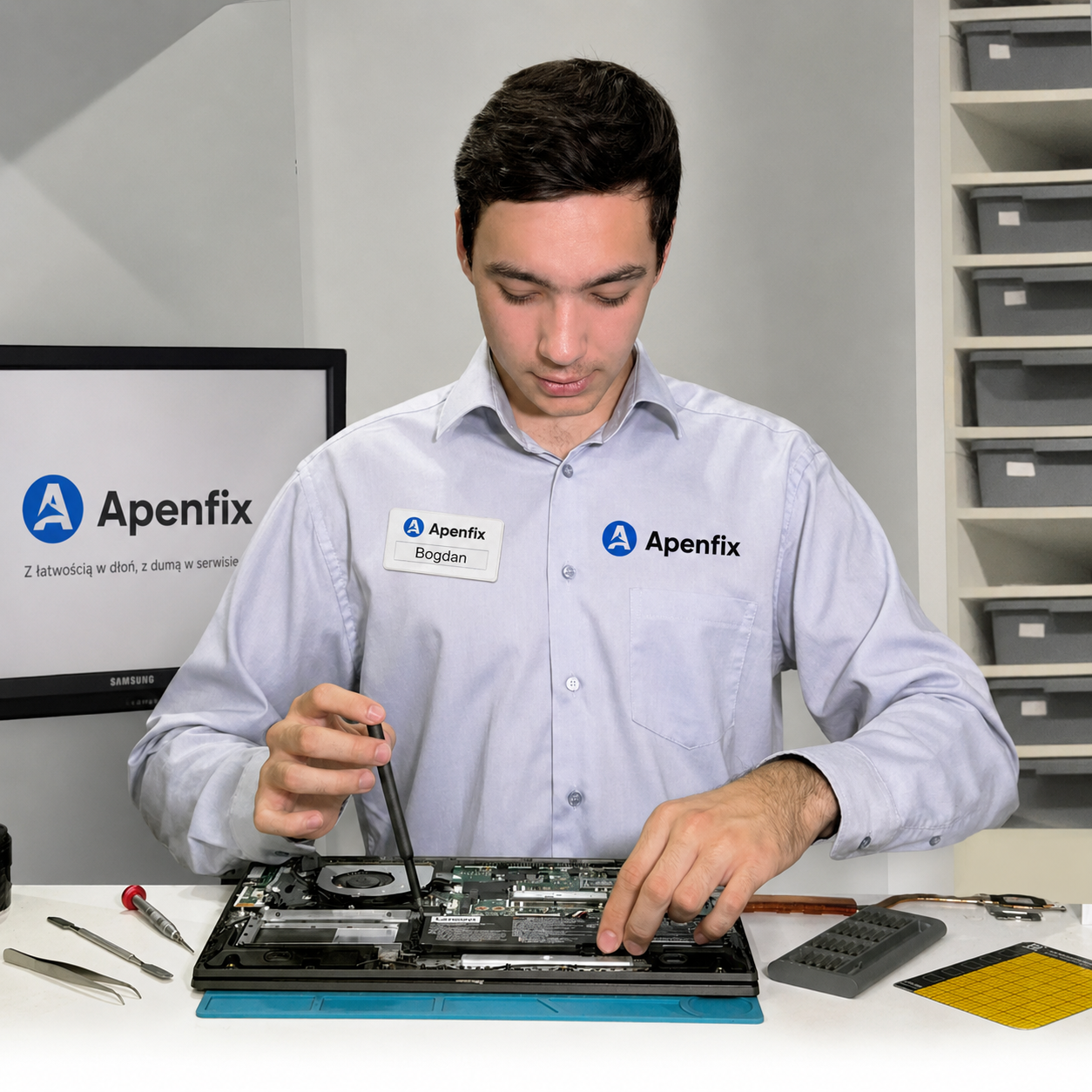
Before we add memory, we always check the client’s Task Manager. Sometimes a laptop has spare RAM but still runs slowly — in that case the culprit is usually the drive. For 2026–2029 we recommend around 16 GB for comfortable work, but it’s always worth verifying this on the specific machine, rather than following a general rule.
Apenfix technician
How we assess this during inspection
1. RAM usage analysis
We check the real memory load during typical use, not just at system startup.
2. Checking upgrade options
We verify whether your laptop model physically allows for adding memory.
3. Drive check
If the symptoms don’t clearly point to insufficient RAM, we also check the drive’s condition.
4. Recommendation
We only recommend an upgrade when it will genuinely solve the problem, and we provide a concrete quote.
The final RAM recommendation depends on how you actually use your laptop and the results of the inspection.
RAM requirement assessment — we serve all of Warsaw
We accept laptops for free RAM requirement assessment from customers in every district of Warsaw — Śródmieście, Wola, Mokotów, Ochota, Żoliborz, Bemowo, Bielany, Ursynów, Praga-Południe, Praga-Północ, Targówek, Białołęka, Wawer, Włochy, Ursus, Wilanów, Rembertów and Wesoła — as well as from the surrounding areas.
We have more than one location in convenient parts of Warsaw, so getting to us is quick and easy wherever you live or work. Our current service point addresses are listed further down this page.
Why Apenfix
Frequently asked questions
How much RAM is enough for web browsing and office work?
8 GB is perfectly sufficient, though with many browser tabs open, 16 GB will give noticeably smoother performance.
How much RAM do I need for graphics, video or gaming?
Here, 16 GB is a sensible minimum for 2026–2029, and for more demanding projects it’s worth considering even more — best to check this with the actual files you work with.
How do I know the problem is RAM and not the drive?
Check Task Manager (Ctrl + Shift + Esc) — if memory is almost fully used, it’s RAM. If you have spare memory but the laptop is still slow, check the drive as well, ideally during a free inspection.
Can every laptop be upgraded to 16 GB?
Not every one — some newer, slimmer models have memory soldered permanently to the motherboard. We check this individually during a free inspection.
The exact cost of a RAM upgrade depends on the laptop model and the chosen memory capacity. You’ll find current rates in the price list.
Two service points in Warsaw
Visit whichever of our two locations is more convenient for you.
Location 1 — Wolska
Wolska 50A/Lokal 26
01-187 Warszawa
Location 2 — al. Szucha
al. Jana Chrystiana Szucha 1
00-580 Warszawa
See also
- RAM upgrade
- Laptop upgrade — RAM and SSD
- Is it worth repairing an old laptop
- Hard drive replacement in Dell laptops